
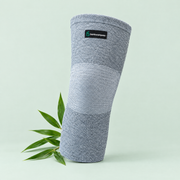
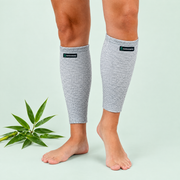
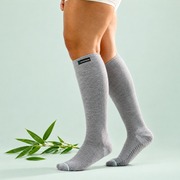
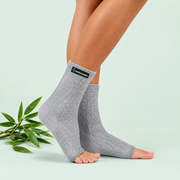

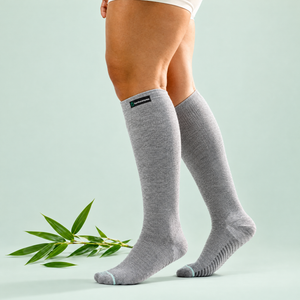
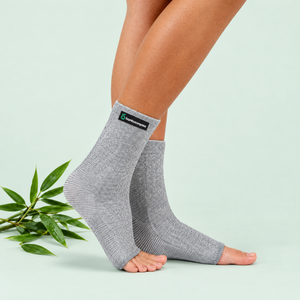


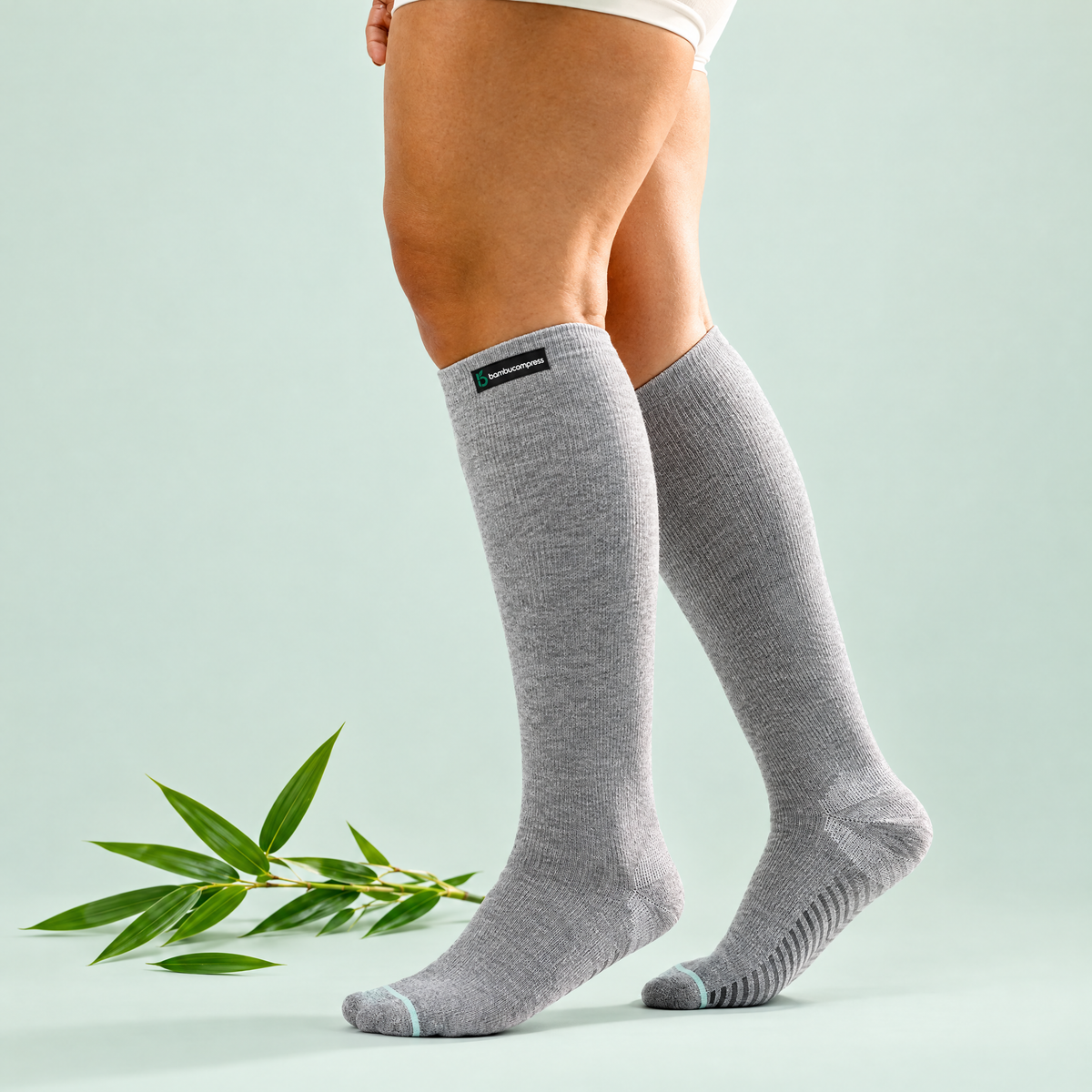
Bamboo compression socks have gone from a niche eco product to the thing nurses, frequent flyers and people with swollen ankles ask about by name. The marketing around them is loud: antibacterial, thermo-regulating, "better than cotton," sometimes "medical grade." Some of that is true, some of it is not, and a lot of it misses the point. This guide answers the question honestly: are bamboo compression socks good, what are the pros and cons, and how do you choose a pair that you will actually wear?
The short answer
Yes, for most people who want everyday compression they can live in, bamboo compression socks are a good choice, and often the most comfortable one. The bamboo part makes the sock softer, cooler and less clammy than cotton or a thick synthetic, which is why people keep them on. But bamboo does not create the compression. That comes from the knit and the spandex, and it is measured in mmHg. So the right way to shop is: decide the compression level you need first, then pick bamboo for comfort. And ignore anything a label says about bamboo being antibacterial.
What "bamboo" socks are actually made of
Almost every bamboo sock on the market is made from viscose (rayon) from bamboo. The plant is pulped, dissolved and spun into a new fibre, the same process used to make ordinary rayon. That fibre is then blended with nylon and spandex, because viscose on its own has no stretch and would not hold compression for a day.
This is not a technicality. In the US, the Federal Trade Commission requires textiles made this way to be labelled "rayon from bamboo" or "viscose from bamboo," and it has fined retailers for calling them simply "bamboo." UK textile labelling rules take the same line: the fibre has to be declared by its generic name, viscose. The FTC also states that rayon from bamboo does not keep the bamboo plant's natural antimicrobial properties, and that there is no reliable evidence the finished fabric is biodegradable. So when a sock promises to be "naturally antibacterial because it's bamboo," that claim has already been rejected by the regulator. What survives the process is what you can feel: a smooth, soft fibre that absorbs and releases moisture well.
Pros of bamboo compression socks
- They feel soft, not scratchy. Viscose has a smooth, silky hand. People with sensitive skin, eczema-prone legs or socks that normally itch notice the difference on day one.
- They run cooler and less clammy. Viscose absorbs moisture and lets it evaporate, so the sock feels drier on a long shift or a warm day than cotton, which holds sweat and gets heavy.
- They are easier to put on. Not because of the bamboo itself, but because bamboo-blend compression socks are usually knit softer and with more give than stiff medical stockings. For stiff hands and limited reach, that matters more than any other feature.
- Less odour. Not antibacterial, but a drier sock gives bacteria less to work with, so bamboo blends tend to smell better at the end of the day than cotton.
- Comfortable to wear all day. This is the real benefit. Compression only helps when it is on your legs, and a sock you forget about is one you keep wearing.
Cons of bamboo compression socks
- Bamboo is not compression. A sock can be 80% bamboo viscose and offer almost no support. Look for a stated compression level or an honest description of how firm it is.
- Viscose is weaker when wet. Heels and toes wear faster than in a nylon-heavy sock unless those zones are reinforced. Wash cold, skip the dryer, and expect a bamboo-blend sock to last a season of daily wear rather than years.
- Thick bamboo knits are warm. A cushioned bamboo sock is cosy in winter and at home, but too much for a hot day; a thin bamboo knit is the one for summer and travel.
- Marketing fluff. "Antibacterial," "hypoallergenic," "eco-friendly" and "medical grade" are on many labels with nothing behind them. Judge the sock, not the adjectives.
- Price. Bamboo blends cost more than basic cotton compression socks, so buy them where comfort matters (daily wear) rather than for a drawer of spares.
Do bamboo compression socks work?
The compression works the same way in any fabric: graduated pressure, tightest at the ankle and easing towards the knee, helps blood and fluid move up the leg instead of pooling. That is why compression socks help tired legs, mild swelling and the heavy feeling after standing all day. The best evidence for compression socks is on long flights: a Cochrane review of nine trials with 2,821 passengers found that below-the-knee stockings cut the rate of symptomless blood clots dramatically (from about 1% to 0.1% in low-risk travellers) on flights over five hours. Both 10-20 mmHg and 20-30 mmHg stockings were used in those trials.
Bamboo changes none of that. What bamboo changes is whether you can tolerate the sock for ten hours. If a cotton or nylon compression sock has been living in your drawer because it is hot and itchy, a bamboo blend at the same compression level will "work" better for the simple reason that you will wear it.
The number that matters: compression level
| Level | Feel | Who it is for |
|---|---|---|
| Gentle / comfort (under 15 mmHg or unrated) | Snug sock, not a squeeze | Tired legs, mild end-of-day puffiness, long shifts, people new to compression. Most bamboo "comfort" socks sit here. |
| 15-20 mmHg (moderate, over the counter) | Noticeably firm at the ankle | Daily swelling, varicose veins, long flights, pregnancy, standing jobs. |
| 20-30 mmHg (firm) | Strong, harder to put on | Usually prescribed: moderate varicose veins, post-surgery, clot prevention, lymphoedema. Ask your doctor. |
| 30-40 mmHg and up | Medical | Prescription only. |
If a bamboo sock does not state an mmHg level, assume it is a gentle comfort sock. That is fine, and it is what most people shopping for bamboo compression socks actually want, but it is not a substitute for a graded stocking your doctor prescribed. If you need 20-30 mmHg, buy a graded medical stocking and wear bamboo socks on your days off.
Bamboo vs cotton vs copper compression socks
| Bamboo viscose blend | Cotton blend | Copper-infused synthetic | |
|---|---|---|---|
| Feel | Soft, smooth, cool | Familiar, can feel rough and heavy when damp | Slick, thin, synthetic |
| Moisture | Absorbs and releases; stays drier | Absorbs and holds; gets heavy | Wicks reasonably |
| Durability | Good if heel and toe are reinforced; weaker when wet | Tougher at the heel | Thin knits wear out |
| Odour | Lower (drier sock) | Higher | Moderate; copper "anti-odor" claims unproven in practice |
| Health claims | "Antibacterial" claims rejected by the FTC; comfort benefits are real | None | No good evidence copper helps pain or swelling; the FTC fined a copper-apparel company for such claims |
| Best for | All-day wear, sensitive skin, warm shifts | Budget spares | Thin everyday wear if the fabric suits you |
How to choose the best bamboo compression socks
- Read the blend. Look for "viscose from bamboo" plus nylon and spandex, with the percentages stated. A sock with no nylon or spandex will not hold compression.
- Match the compression to the job. Comfort sock for tired legs and shifts; 15-20 mmHg for daily swelling, flights and pregnancy; 20-30 only if prescribed.
- Size by shoe size and calf. Most bamboo socks size by UK shoe size. If you have wider calves, size up or look for a wide-calf version; a top band that digs in is the main reason socks get abandoned.
- Pick the weight for the season. Thick, cushioned bamboo for winter, home and hard floors; thin bamboo knit for summer, dress shoes and travel.
- Check the heel and toe. Reinforced zones make a bamboo sock last. A smooth or hand-linked toe seam is kinder to toes and anyone with neuropathy-sensitive feet.
- Grip soles for home. If you will wear them around the house, grip dots on the sole are a real safety feature on wood and tile.
- Ignore the magic words. Antibacterial, thermo-regulating, odor-proof and medical-grade mean nothing unless they come with a compression rating or a test.
Who should talk to a doctor first
Compression is not right for everyone. Ask your doctor before wearing compression socks if you have peripheral artery disease or poor circulation, diabetes with reduced feeling in your feet, neuropathy, skin infections or fragile skin, severe heart failure, or sudden swelling in one leg (which needs urgent assessment). People with neuropathy often like the softness of bamboo, but the compression level and fit should be chosen with a clinician.
Where our socks fit in
We make three bamboo compression socks, all knit from viscose from bamboo blended with nylon and spandex, all unisex and sized by UK shoe size, and all honestly labelled as gentle, everyday-comfort compression rather than graded medical stockings. EASE+ Bamboo Compression Socks are the thick, cushioned knee-high with grip or no-grip soles, made for swollen feet, long shifts and relaxing at home. AIR+ Lightweight Bamboo Compression Socks are the thin, cool, extra-stretch pair for travel, summer and dress shoes. STEADY+ Cushion Crew Socks add a padded sole and arch compression for plantar fasciitis and hard floors. Compare them all in our bamboo compression socks collection; every pair comes with a 30-day comfort guarantee.
Related reading: compression socks for flying, how to put on compression socks easily, and the benefits of compression socks.
Sources
- U.S. Federal Trade Commission. Enforcement on "bamboo" textile labeling: rayon from bamboo must be labelled as such; antimicrobial and biodegradability claims unsupported (summary by SGS, 2022).
- Clarke MJ, Broderick C, Hopewell S, Juszczak E, Eisinga A. Compression stockings for preventing deep vein thrombosis in airline passengers. Cochrane Database of Systematic Reviews. 2021.
- American Family Physician. Compression stockings for preventing deep venous thrombosis in airline passengers. 2022.
- The NHS. Compression stockings.
- U.S. Federal Trade Commission. Tommie Copper to pay $1.35 million to settle FTC deceptive advertising charges. 2015.
This article is for general information and is not medical advice. Read our medical disclaimer.

 Knee Brace vs Knee Sleeve: Which One Do You Actually Need?
 Best Knee Compression Sleeve for Arthritis: Bamboo vs Copper vs Neoprene
 Do Arthritis Gloves Work? What the Research Says (and What It Doesn't)