



If your fingers feel stiff and sore when you wake up, you have probably seen arthritis gloves recommended in a support group, by a friend or in an ad. They look simple: a snug, stretchy glove you wear at night or during the day. But do arthritis gloves work, or is it mostly marketing? This guide walks through what the research actually found, what it did not find, and how to choose a pair if you decide to try them.
The short answer
Arthritis gloves can make hands feel warmer and more comfortable, and many people who try them keep wearing them. What the research does not support is the idea that the compression itself is doing something special. In the largest trial so far, tight compression gloves and looser warm gloves helped about the same. So the honest way to think about them is as a comfort aid: low risk, inexpensive, and worth trying if warmth tends to help your hands, but not a treatment for arthritis.
What arthritis gloves are
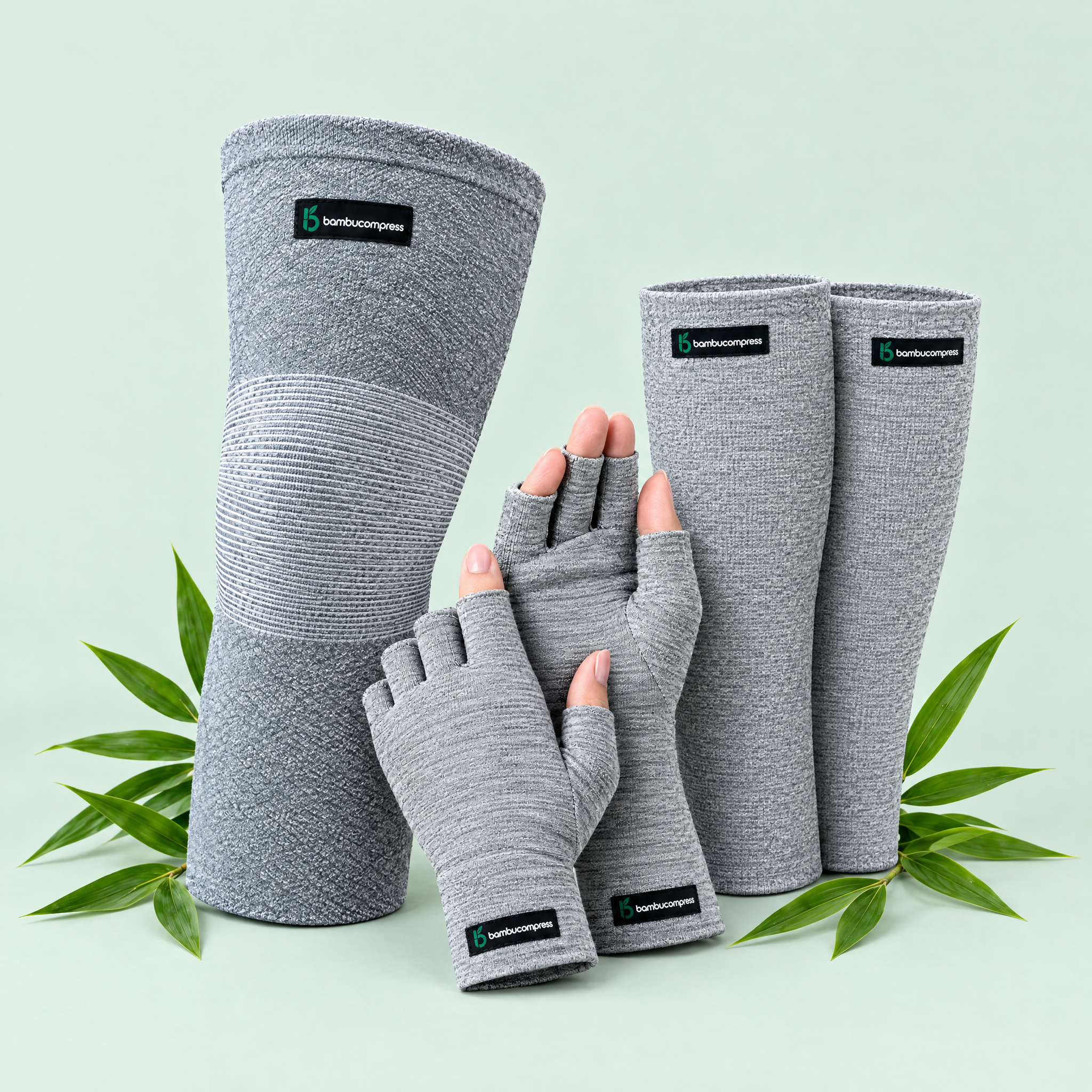
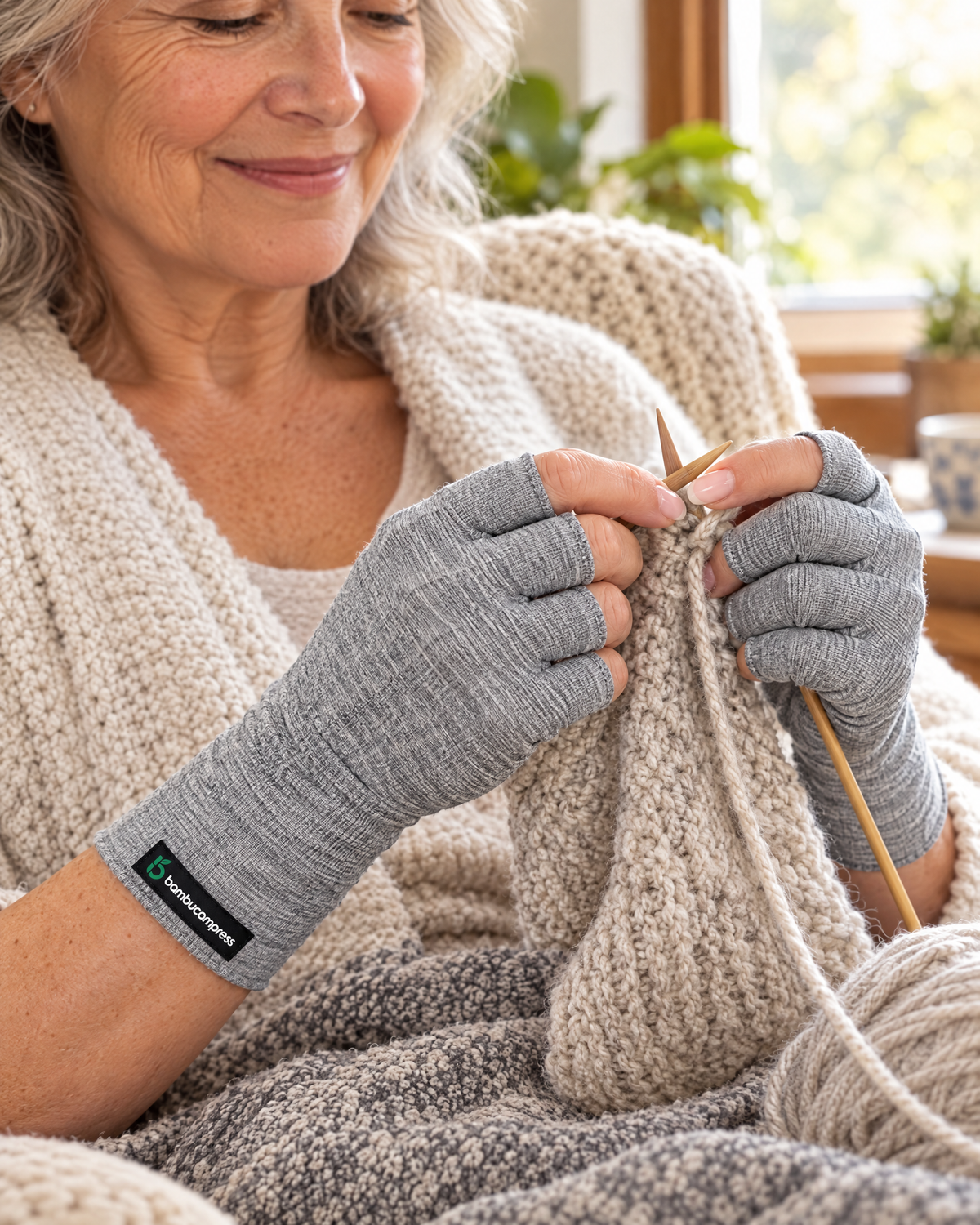
Most "arthritis gloves" are compression gloves made from a stretchy knit, usually cotton, nylon or bamboo viscose blended with spandex. They fit snugly around the palm, knuckles and wrist. Some cover the whole finger; many are open at the fingertips so you can still feel what you are touching. Some are sold mainly for warmth and are looser. There are also rigid splints and thumb braces, which are a different thing: they hold a joint in position rather than gently squeezing the hand.
When people search for compression gloves for arthritis, they usually mean the soft, snug, fingerless kind. That is what most of the studies below looked at too, although several tested full-finger gloves worn at night.
What the research shows
A review of the early trials
In 2016, researchers at the University of Salford reviewed every randomised trial they could find on compression gloves for rheumatoid arthritis and hand osteoarthritis. There were only four, with 74 people in total, and all tested full-finger gloves worn at night against "placebo" gloves. In rheumatoid arthritis, compression gloves reduced finger joint swelling, but results for pain and stiffness were inconclusive, and grip strength and dexterity did not change. For hand osteoarthritis there was a single, very small study, which found no difference. The authors concluded that the evidence was inconclusive and that all the trials were too small to be sure either way.
The A-GLOVES trial
The same team then ran a much larger trial, published in 2021. It included 206 adults with rheumatoid arthritis or undifferentiated inflammatory arthritis and ongoing hand pain, at NHS clinics in England and Scotland. Half received fitted compression gloves. The other half received loose-fitting gloves that kept the hands just as warm but gave no real compression. Occupational therapists fitted both, and everyone also got hand exercises and advice on protecting their joints.
After 12 weeks, hand pain had improved by a similar small amount in both groups. The difference between them on a 0 to 10 pain scale was 0.1 point, which is no real difference at all. About 73% of people in each group said their gloves were beneficial, and the reasons they gave most were warmth and comfort. The tighter gloves had a downside: more people wearing them reported problems such as pins and needles or numbness. The researchers' conclusion was that compression is not the "active ingredient" in arthritis gloves, and the UK's National Institute for Health and Care Research suggested that people could try ordinary, lightweight fingerless gloves instead of expensive specialist ones.
What arthritis guidelines say
The 2019 American College of Rheumatology and Arthritis Foundation guideline (widely referenced by UK clinicians alongside NICE guidance) for osteoarthritis does not make a specific recommendation about compression gloves. It strongly recommends hand orthoses (splints) for arthritis at the base of the thumb, conditionally recommends them for other hand joints, and conditionally recommends local heat or cold. It notes that gloves may offer benefit by providing warmth and compression to the hand. Put simply, gloves sit in the same "may help you feel more comfortable" category as warmth, not in the category of proven treatments.
What the research does not show
- No evidence they slow arthritis. No study has shown that gloves change joint damage, inflammation or how the disease progresses.
- Little data on hand osteoarthritis. Most trials were in rheumatoid or inflammatory arthritis. Osteoarthritis, which is far more common in people over 50, has barely been studied.
- No proof that tighter is better. The best trial suggests the opposite: snugger gloves gave no extra benefit and more side effects.
- No head-to-head comparisons of brands or fabrics. Nobody has tested whether cotton, copper-infused or bamboo gloves work better than one another. Any brand that claims otherwise is going beyond the evidence.
Who might like arthritis gloves
Gloves tend to suit people whose hands feel better when they are warm: stiffness first thing in the morning, achy knuckles on cold days, or hands that feel tight after hours of typing, gardening or knitting. They are also easy to try. If a pair helps you feel more comfortable, that is a reasonable reason to keep using it.
Check with your doctor first if you have poor circulation, diabetes with reduced feeling in your hands, Raynaud's, skin wounds or fragile skin, or swelling from lymphoedema, which needs properly prescribed compression garments. And keep following your treatment plan. Gloves sit alongside medicine, exercise and hand therapy, not in place of them. Versus Arthritis and the NHS both have good overviews of the treatment options for hand arthritis.
How to choose the best compression gloves for arthritis
Since warmth and comfort seem to be what matters most, the best compression gloves for arthritis are the ones you will actually keep on. A few things make that more likely:
- Snug, not tight. You should be able to make a loose fist. If your fingers tingle, go numb or change colour, take the gloves off and size up.
- Measure properly. Most brands size by the width of the palm just below the knuckles, without the thumb. If you are between sizes or your knuckles are enlarged, go up a size.
- Breathable fabric. A soft knit that lets air through is more pleasant for long wear and for sleeping.
- Fingerless for daytime. Open fingertips let you use your phone, cook and do crafts without taking the gloves off. Full-finger styles can feel cozier at night.
- Two pairs if you wear them daily. One can dry while you wear the other.
Give a new pair a couple of weeks of regular wear before deciding whether it helps. Comfort is personal, so trust how your hands feel.
Where our gloves fit in
We make the FLEX+ Bamboo Compression Gloves with these findings in mind: a soft, breathable bamboo knit, gentle rather than tight compression, and open fingertips for everyday tasks. We do not claim they treat arthritis, because the evidence does not support that for any glove. We think they are a comfortable option if warmth helps your hands. You can compare colours and read sizing tips on our compression gloves for arthritis page, and every pair comes with a 30-day comfort guarantee.
Sources
- Hammond A, Jones V, Prior Y. The effects of compression gloves on hand symptoms and hand function in rheumatoid arthritis and hand osteoarthritis: a systematic review. Clinical Rehabilitation. 2016;30(3):213-224.
- Hammond A, Prior Y, Cotterill S, et al. Clinical and cost effectiveness of arthritis gloves in rheumatoid arthritis (A-GLOVES): randomised controlled trial with economic analysis. BMC Musculoskeletal Disorders. 2021.
- NIHR Evidence. Special arthritis gloves no better than looser-fitting alternatives. 2021.
- Kolasinski SL, Neogi T, Hochberg MC, et al. 2019 American College of Rheumatology/Arthritis Foundation Guideline for the Management of Osteoarthritis of the Hand, Hip, and Knee. Arthritis & Rheumatology. 2020;72(2):220-233.
- NHS. Arthritis.

 Are Bamboo Compression Socks Good? Pros, Cons and How to Choose the Best Pair
 Knee Brace vs Knee Sleeve: Which One Do You Actually Need?
 Best Knee Compression Sleeve for Arthritis: Bamboo vs Copper vs Neoprene